Board and director governance
BGR
Governance-assurance software for not-for-profit and corporate boards. It prepares, runs and records every meeting, and checks the governance before the meeting starts.
The gap we found
Board portals were built to solve document distribution, and they solved it. Twenty years of boardroom experience says that was never the weak point.
Governance fails on two other things. Directors arrive underprepared, not from indifference, but because a 300-page package sent the Friday before does not tell a director what has changed or what they are being asked to decide. And information reaches the table wrong or late, so a decision gets made on a number that has already moved.
Neither problem is fixed by better storage. Both are fixed by preparing the package differently: checking it against the board’s own governance rules first, then reducing it, per director, to what that person has to decide and what they are entitled to see.
That is a different product from a portal, and it is why BGR is built around the brief rather than the document library.
The personalized director brief
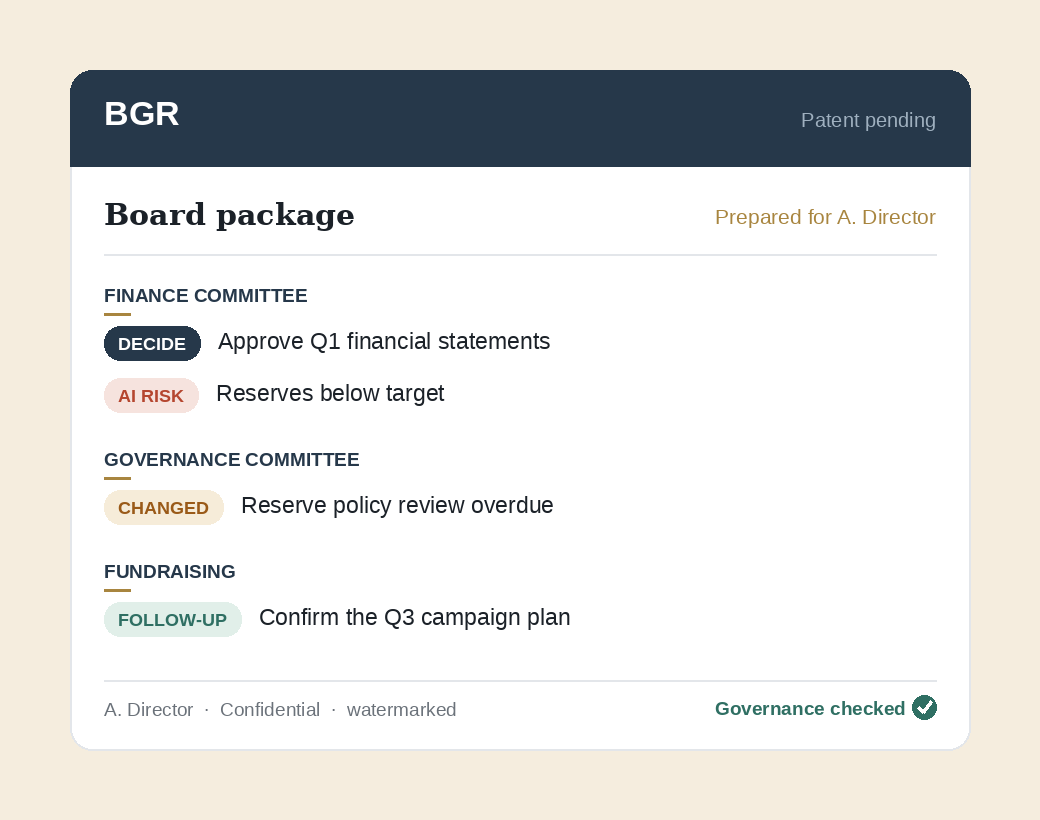
Before every meeting, each director receives their own watermarked brief, organized by committee and governance area: what to decide, what changed since last time, the risks attached, and the items still open from prior meetings.
It shows only what that director’s role allows. Committee membership and in-camera status are respected in the brief itself, not just in the folder permissions.
What the software does
Across the full meeting cycle, not just the meeting itself.
Before: governance checks
Agenda construction with documents attached, then automated checks on quorum, policy and committee mandate before the package is issued.
Before: director briefs
Personalized, watermarked briefs by governance area, with optional AI research across past minutes and decisions to surface what has already been settled.
During: live capture
Minutes captured live by voice or quick buttons, resolutions recorded with vote tracking, and a shared note stream for participants.
During: in camera
In-camera sessions restricted to directors, handled as a first-class part of the meeting record rather than a gap in it.
After: the record
Minute tidying and approval workflow, a resolution register of every decision, follow-up and open-item tracking, and access logs showing who viewed what.
Throughout: your data
The record stays in your own board portal or storage. AI is optional. A working copy is held 30 days or deleted sooner by the administrator, and data is never used to train AI.
Where the design came from
BGR comes out of twenty years in the boardroom and a Chartered Director’s view of risk. The governance model was specified by someone who has sat on the receiving end of a bad board package, then engineered by MarkR’s developers. The methodology is patent pending.